

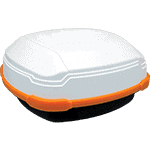
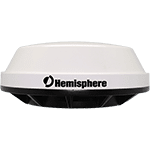
The R632™ GNSS receiver is a full solution product in a compact enclosure. The R632™ utilizes Hemisphere GNSS’ all-new Lyra™ II digital ASIC platform and our latest GNSS patented technology. The R632™ provides accurate positioning using several differential correction methods such as Athena™ RTK, Atlas® L-band corrections (Atlas Basic, H30, H10), and SBAS.


Product details
Package includes
Atlas is Hemisphere’s industry-leading global correction service, which can be added as a subscription to the R632™. Atlas delivers world-wide centimeter level correction data over L-band communication satellites. With Atlas, R632™ users are able to experience sub-decimeter positioning performance anywhere on earth, without the need to be near a GNSS or communication infrastructure.
Yes. The R632 supports base station operation and can provide GNSS correction data to other receivers through UHF radio or IP-based connections. Its Ethernet, cellular, and other communication interfaces give you flexibility when setting up a reference station for surveying, construction, machine control, or other positioning applications.
The R632 supports Hemisphere Athena RTK, Atlas L-band corrections, and SBAS. RTK is suitable for centimeter-level positioning using a compatible base station or network, while Atlas provides satellite-delivered corrections without requiring a nearby reference station or cellular connection. The accuracy available through Atlas depends on the selected service level.
Yes. The R632 supports NTRIP Client, Server, and Caster functions, allowing it to work within different network-based correction setups. It also supports UHF radio communication, so the appropriate configuration depends on the available communications infrastructure and the correction workflow required by your project.
Yes. With a suitable Atlas L-band subscription, the R632 can receive satellite-delivered corrections without relying on a nearby GNSS base station or cellular data connection. Hemisphere specifies horizontal RMS accuracy of 4 cm for Atlas H10, 15 cm for H30, and 0.5 m for Atlas Basic, so the appropriate service level depends on your accuracy requirements.
The R632’s standard configuration provides a single-antenna position solution, but it can be upgraded to support dual-antenna heading. This requires an additional activation and a second GNSS antenna, with antenna separation and installation orientation affecting the resulting heading performance. This feature can be particularly useful for marine navigation, vehicle positioning, and applications where direction is needed even when the platform is moving slowly.
Hemisphere specifies RTK accuracy of 8 mm + 1 ppm horizontally and 15 mm + 1 ppm vertically under its stated conditions. Actual field results depend on factors including baseline length, satellite geometry, multipath, atmospheric conditions, and correction quality, so these specifications should not be treated as guaranteed results for every installation.
The R632 is specified for RTK baselines of up to 50 km under suitable conditions. Actual performance at longer baselines depends on the correction method, communications link, satellite conditions, and the environment at both the reference station and rover. For a specific project, the available correction service and required accuracy should guide the setup.
The receiver supports correction formats including RTCM 2.3, RTCM 3.2, CMR, and CMR+, along with NMEA 0183 and NMEA 2000 data output. Its Ethernet, CAN, serial, USB, Bluetooth, and Wi-Fi interfaces provide several ways to integrate the receiver into compatible survey, marine, and machine-control systems. Compatibility depends on the required protocol, interface, and configuration of the connected equipment.
The R632 is specified to operate from -30°C to +65°C and has published protection ratings of IP6x, IPx6, and IPx7. These specifications support use in demanding outdoor environments, including many Canadian field conditions, although the installation, power supply, antenna mounting, and protection of external connections still need to be appropriate for the site.

Navigating the learning curve independently can be daunting, which is why we offer a solution to simplify your journey. Our program features twice-weekly training sessions designed to accommodate your schedule, making it ideal for onboarding new team members or resolving specific queries through live demonstrations on Zoom.
View Info
Learning a new software package can be daunting, but we have got you covered. That is why we created the Bench-Mark Survey Academy, where you can learn at your own pace. With over 15 hours of content in our library, you can access it on your own time and conquer new skills with ease. But don’t let that overwhelm you, it takes only 20 minutes to get up and running.
View Info


Barry Brake –
When it comes to service and support, Bench Mark has it nailed. Our purchase of an R632 GNSS Receiver was flawless. We will definitely be a repeat customer.