

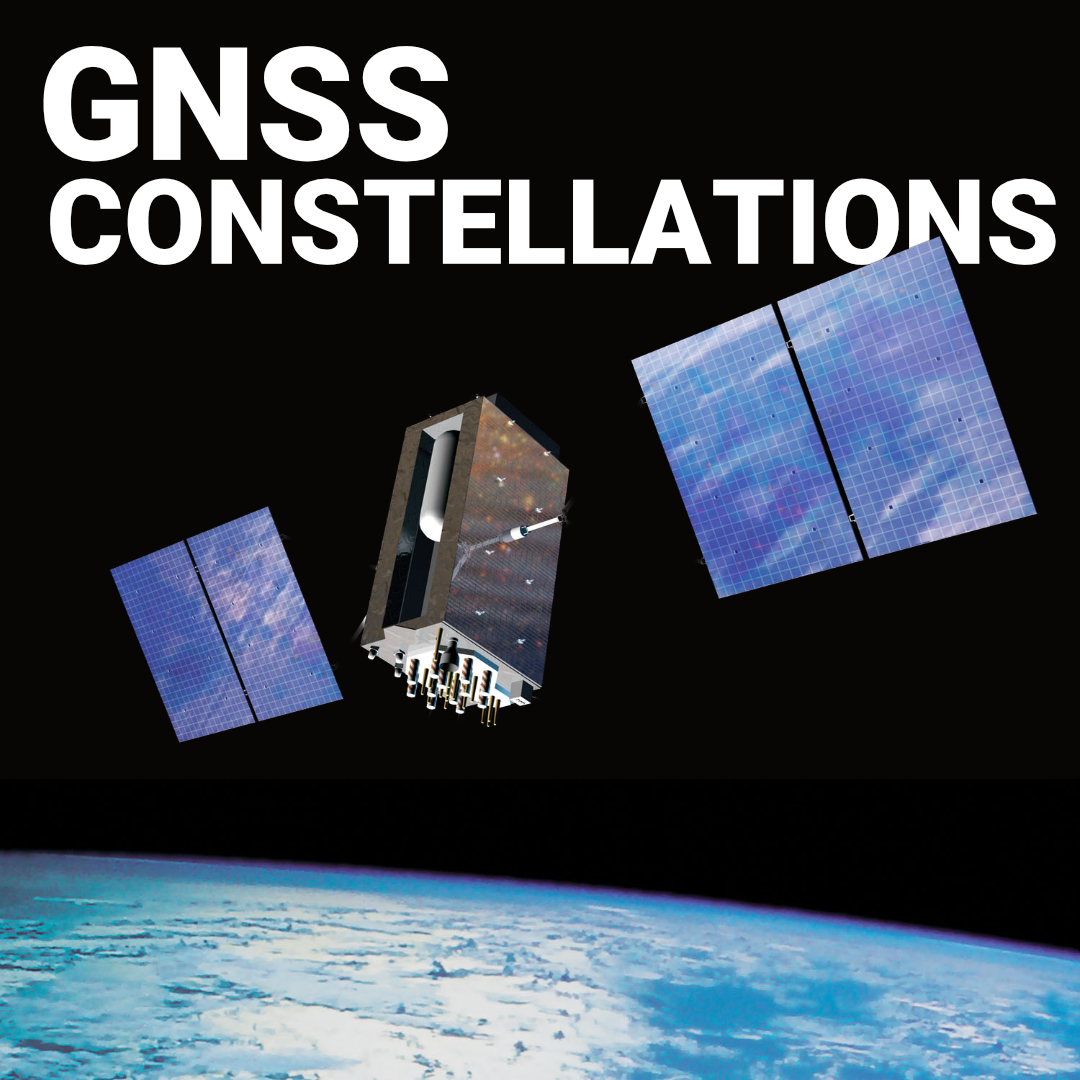
When you set up your rover or base station, you’ll see options to enable different constellations in your receiver settings. GPS alone? GPS + GLONASS? All constellations? The choice affects your satellite availability, fix time, and accuracy.
What Are GNSS Constellations?
GPS: The Original Standard
GLONASS: Better Coverage in Northern Latitudes
Galileo: Europe’s High-Precision System
BeiDou: Global Coverage with High Satellite Density
Why Multi-Constellation Matters in the Field
How to Configure Multi-Constellation Tracking
Future-Proofing Your Setup
More Satellites Mean Better Data
GNSS stands for Global Navigation Satellite System. It’s the term for any satellite-based positioning system that provides global coverage. GPS is one GNSS constellation. GLONASS, Galileo, and BeiDou are others.
Each constellation is a network of satellites orbiting Earth. They transmit signals that your receiver uses to calculate position. The more constellations your receiver can track, the more satellites it has access to. More satellites mean better geometry, faster fixes, and more reliable performance when line of sight is limited.
In surveying, where centimeter-level accuracy matters, extra satellite coverage means fewer dropouts and shorter initialization times. You’ll also see better vertical accuracy under canopy, near buildings, or on steep slopes.
GPS (Global Positioning System) was developed by the United States Department of Defense. It became fully operational in the 1990s. GPS currently operates with at least 24 satellites in medium Earth orbit. This ensures global coverage 24/7.
GPS satellites broadcast on multiple frequencies. Older receivers use L1 only. Modern survey-grade systems use L1 and L2, and increasingly L5. The dual-frequency capability allows you to resolve ambiguities quickly and maintain a fixed solution in challenging conditions.
GPS is still the baseline for professional surveying. Systems like the Hemisphere S631 and our GeoMeasure Nano 7 use GPS as their primary constellation. But they don’t stop there. Relying on GPS alone means you’re limited to around 6-10 visible satellites at most times. Add other constellations, and that number jumps to 20 or more.
GLONASS (Global Navigation Satellite System) is Russia’s satellite positioning system. Fully operational since 1995, GLONASS maintains a constellation of 24 satellites. What sets GLONASS apart is its orbital configuration. Satellites are positioned differently than GPS, which gives better coverage at high latitudes.
If you’re working in Canada, especially in northern regions, GLONASS makes a noticeable difference. The satellite geometry is stronger. You’ll often see more GLONASS satellites above the horizon than GPS satellites in those areas. This is why most surveyors in Canada run GPS + GLONASS by default.
GLONASS uses a different frequency plan than GPS. While GPS satellites share the same frequencies and use different codes, each GLONASS satellite transmits on a slightly different frequency. This makes GLONASS signals more resistant to certain types of interference. It also requires receivers to have more sophisticated filtering.
Combining GPS and GLONASS is one of the easiest ways to improve RTK performance without changing your workflow. You get more satellites, better fix reliability, and faster convergence times. This is particularly valuable in urban environments or around heavy equipment.
Galileo is the European Union’s GNSS constellation. It became operational in 2016 and now has over 20 active satellites. Galileo was designed to be more accurate than GPS for civilians, with better signal structure and improved resilience to interference.
One of Galileo’s standout features is its dual-frequency signals on all satellites. This means even basic Galileo receivers can achieve better accuracy than single-frequency GPS receivers. For surveyors using multi-frequency systems like the Hemisphere S631, Galileo adds another layer of redundancy and precision.
Galileo also broadcasts a Search and Rescue (SAR) service. This isn’t directly useful for surveying, but it highlights the system’s focus on safety and reliability. More relevant to fieldwork is Galileo’s consistent signal quality. The constellation was built with civilian use in mind. The signals are optimized for accuracy rather than military flexibility.
In Canada, Galileo coverage is strong. Enabling it alongside GPS and GLONASS can push your visible satellite count well into the 20s. That kind of satellite availability shortens your initialization times. It keeps you locked in RTK even when part of the sky is obstructed by buildings, trees, or terrain.
In addition, the new HAS (High Accuracy Service) provides 10 cm accuracy for compatible receivers.
BeiDou is China’s GNSS constellation. It started as a regional system focused on the Asia-Pacific region. It expanded to full global coverage in 2020. BeiDou now operates 35 satellites, more than any other constellation. It offers positioning services worldwide.
BeiDou’s strength is its density. With more satellites in orbit, you’re more likely to have strong geometry no matter where you are. The system also includes geostationary satellites over the Asia-Pacific. These provide consistent, high-elevation coverage in that region. For North American surveyors, BeiDou functions similarly to GPS or Galileo. It’s another constellation that adds satellite count and improves fix reliability.
One unique feature of BeiDou is its short message service. This allows two-way communication through the satellites themselves. It isn’t commonly used in surveying, but it shows BeiDou’s versatility beyond just positioning.
Most modern GNSS receivers support BeiDou alongside the other major constellations. This includes those running FieldGenius software. Enabling it gives you access to more satellites and better redundancy. This is especially valuable in environments where GPS alone struggles to maintain a fix.
The real advantage of multi-constellation GNSS isn’t just more satellites. It’s better satellite geometry. Your receiver calculates position based on the angles between satellites and your location. The more spread out those satellites are across the sky, the better your positional dilution of precision (PDOP). Lower PDOP means more accurate coordinates.
Running GPS + GLONASS + Galileo + BeiDou gives you several benefits:
This is why systems like the Hemisphere S631 and GeoMeasure Nano 7 are configured to track all major constellations by default. You’re not just buying a GPS receiver. You’re getting access to a global network of over 100 satellites that work together to keep you accurate and productive.
Most survey-grade receivers let you choose which constellations to enable. Here’s what to consider.
Always enable GPS. It’s the most established system, with the best global coverage and the longest track record in professional surveying.
Add GLONASS if you’re in Canada or northern latitudes. The orbital configuration gives you better sky coverage and more reliable fixes in these regions.
Enable Galileo for maximum accuracy. Galileo’s signal quality and dual-frequency design make it one of the best constellations for precision work.
Turn on BeiDou for extra redundancy. It doesn’t hurt to have more satellites. BeiDou’s growing presence makes it a solid backup in any environment.
The only reason not to enable all constellations is if your receiver’s processing power is limited. You might also skip certain constellations if you’re working in an area with known interference on certain frequencies. Otherwise, more is better.
GNSS constellations are constantly evolving. GPS is launching new satellites with improved signals, including L5. Galileo is expanding its coverage. BeiDou continues to grow. GLONASS is modernizing its constellation with better frequency plans.
This means your equipment will only get better over time. But only if it’s capable of tracking multiple constellations. When you invest in a receiver like the Hemisphere S631 or GeoMeasure Nano 7, you’re not just buying current performance. You’re buying into a system that will improve as more satellites come online and signal structures get better.
If you’re still running single- or dual-constellation equipment, you’re leaving accuracy and reliability on the table. The cost difference between a GPS-only receiver and a multi-constellation system is minimal. It’s negligible compared to the time you’ll save in the field and the confidence you’ll have in your data.
GNSS constellations aren’t just a technical detail buried in your receiver’s settings. They’re the foundation of how your system performs in real conditions. GPS alone is reliable. GPS + GLONASS + Galileo + BeiDou is better. You get faster fixes, better accuracy, and fewer problems when the environment isn’t perfect.At Bench-Mark, we’ve built our systems around multi-constellation tracking. We know it’s what separates good data from great data. Whether you’re running RTK on a subdivision layout or setting control for a highway project, the constellations you enable make a difference. When you can see more of the sky, you can trust your coordinates.
