

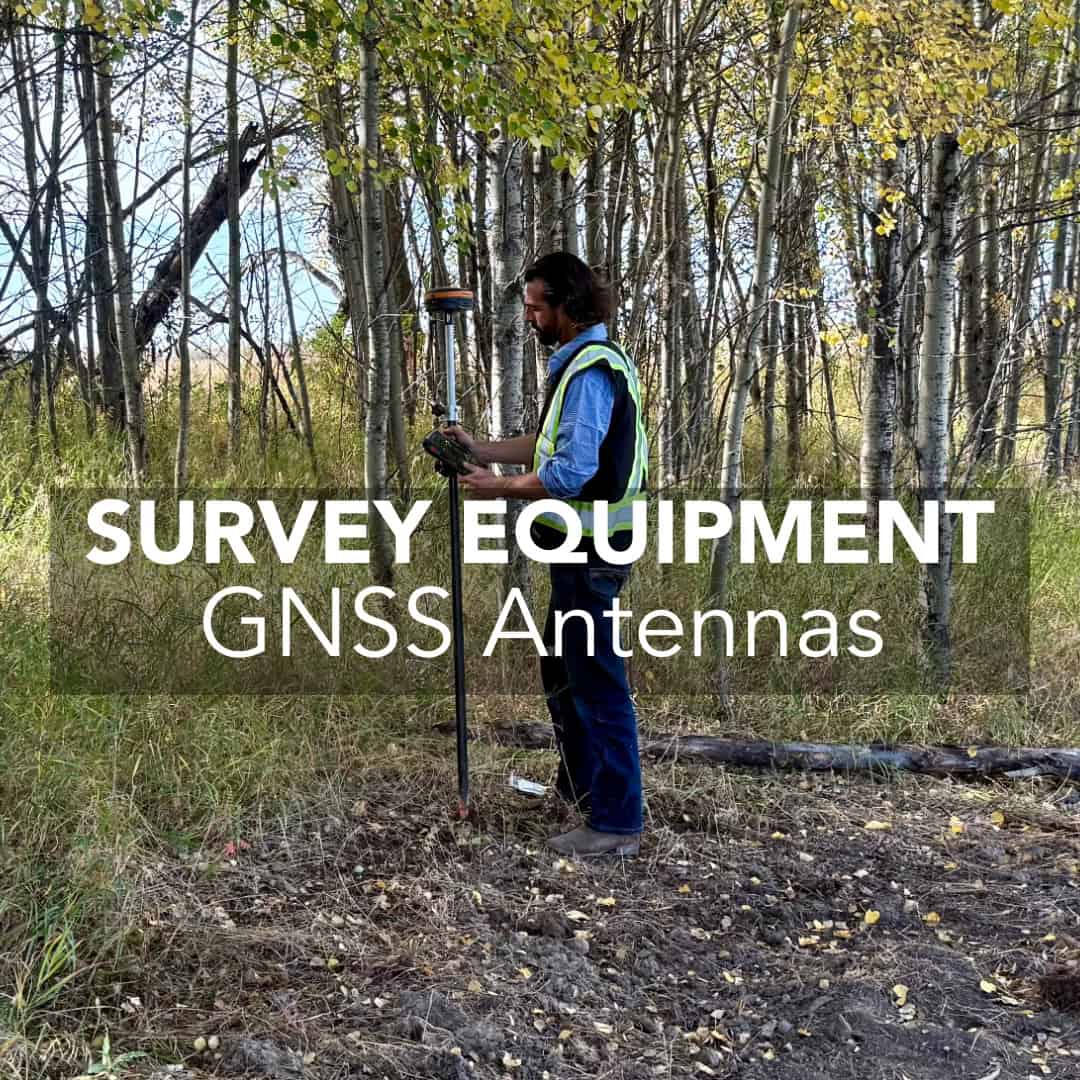
Choosing the right GNSS antenna is one of the most overlooked decisions in a survey setup that can make or break your accuracy. Your antenna’s performance determines how well your system sees the sky, handles interference, and maintains fix quality in the field. In this guide, we’ll tell what really matters when choosing a GNSS antenna and how to match the right one to your workflow.
Why the GNSS Antenna Matters
GNSS vs GPS Antennas: What’s the Difference?
The Key Antenna Parameters You Should Know
Types of GNSS Antennas for Surveying
Matching the Antenna to Your Workflow
Don’t Forget: Integration Matters
Durability and Environmental Resistance
Compatibility: Make Sure Everything Talks
The Antenna Is the Foundation of Your Accuracy
FAQs
Think of your antenna as your receiver’s eyes. It’s the first thing that interacts with the satellites. If the antenna can’t clearly “see” the sky, the receiver can’t do its job properly. A great receiver with a poor antenna will struggle with the same problems as an average system: weak signal strength, multipath errors, and unstable fixes. On the other hand, a properly matched GNSS antenna brings:
Surveyors often upgrade their receiver but forget that the antenna is what makes that precision possible in the first place.
You’ll often see antennas labeled “GPS” or “GNSS.” While they sound similar, the distinction matters.
The advantage is clear: more satellites = better accuracy and reliability. When you lose line of sight to part of the sky (near trees, buildings, or slopes) a GNSS antenna keeps your receiver locked in with other constellations.
So, while every GNSS antenna can handle GPS, not every GPS antenna is capable of full GNSS performance. For professional surveying, always go GNSS.
Before you compare brands or models, it helps to understand what actually separates a high-quality GNSS antenna from a basic one. Here are the main specs that affect field performance:
Gain describes how well the antenna amplifies incoming signals. Higher gain means better reception in challenging environments, but too high a gain can introduce distortion. For most fieldwork, a balanced gain (around 4-6 dBic) provides solid, stable performance without oversaturation.
Every antenna has a “phase center”. It’s the point from which it measures the satellite signal. The smaller and more stable the offset and variation, the more consistent your data.
Survey-grade antennas (like those on the Hemisphere S631) are calibrated to minimize PCO/PCV errors to just a few millimeters.
This measures how well the antenna rejects reflected signals (multipath). A low axial ratio (below 2 dB) means better performance around reflective surfaces like water, vehicles, or metal structures.
This affects timing accuracy, especially in RTK and PPK applications. Consistent group delay across all frequencies ensures that your rover and base stay synchronized.
Different job types call for different antenna designs. Here’s a breakdown of the main categories you’ll come across.
These are the gold standard for permanent installations or control stations. They’re highly stable, often come with radomes, and offer the best multipath rejection. Use them when absolute accuracy is critical for CORS setups, monitoring, or base stations that stay in one place for long periods.
These are what most surveyors use in day-to-day RTK work. They’re compact, durable, and designed for easy mounting on poles or tripods.
These antennas are small and inexpensive but less precise. They can work well for mapping or GIS-grade applications, but aren’t ideal for centimeter-level surveying.
Choosing the “best” GNSS antenna isn’t about specs alone; it’s about fit. Ask yourself a few key questions:
If you move between sites daily, choose a lightweight, rugged antenna that mounts easily on a pole or tribrach. If you leave your base fixed, prioritize stability and multipath rejection.
Dense canopy, urban areas, or open plains all demand different designs. For obstructed environments, look for a choke-ring or ground-plane antenna that reduces multipath. For open-sky work, a lighter dome-style antenna is usually more than enough.
Even the best antenna can perform poorly if not mounted or integrated correctly.
A well-integrated antenna setup can improve your fix reliability as much as upgrading to a new receiver.
Surveying doesn’t stop for the weather. Your GNSS antenna should be just as rugged as your receiver. Look for:
Before buying, double-check compatibility with your receiver and data collector. Most survey-grade GNSS antennas use standard TNC or SMA connectors and are compatible across systems. Still, pay attention to frequency support: if your receiver is multi-frequency (L1/L2/L5), your antenna must support those bands as well. If you’re using FieldGenius software, make sure your receiver’s firmware properly recognizes your antenna model to apply correct PCO/PCV offsets automatically.
Your GNSS antenna is the foundation of every coordinate you collect. When you match the right antenna to your workflow, environment, and receiver, you’ll see immediate improvements in reliability, fix time, and precision. At Bench-Mark, we’ve helped surveyors fine-tune their setups for every condition imaginable. Our team can help you choose the right GNSS antenna and configuration to get the accuracy you’re after. Because accuracy starts at the antenna.
A GPS antenna tracks only U.S. GPS satellites. A GNSS antenna tracks multiple constellations (GPS, GLONASS, Galileo, BeiDou), giving better coverage and reliability.
In most setups, both the base and rover use identical antennas for consistency in phase measurement. Matching antennas ensure your RTK corrections stay accurate.
High-quality antennas can last for years. Replace only if you notice physical damage, connector wear, or inconsistent tracking performance.
Yes, as long as it’s dual- or multi-frequency and properly calibrated. Static (PPK) surveys just benefit from longer observation times.
Yes. The longer the cable, the greater the signal loss. Keep cables as short as practical and use low-loss coaxial lines rated for GNSS frequencies.
